

 Too busy?
 Back
Back

 What customers say


.png?width=32&height=32&name=Microcassette%20(1).png)


.png?width=32&height=32&name=laser%20disc%20(1).png)

 Digital Services

.webp)
.png)

.png)

%20(70).png)
%20(67).png)
%20(71).png)
%20(1126%20x%20658%20px)%20(4).png)







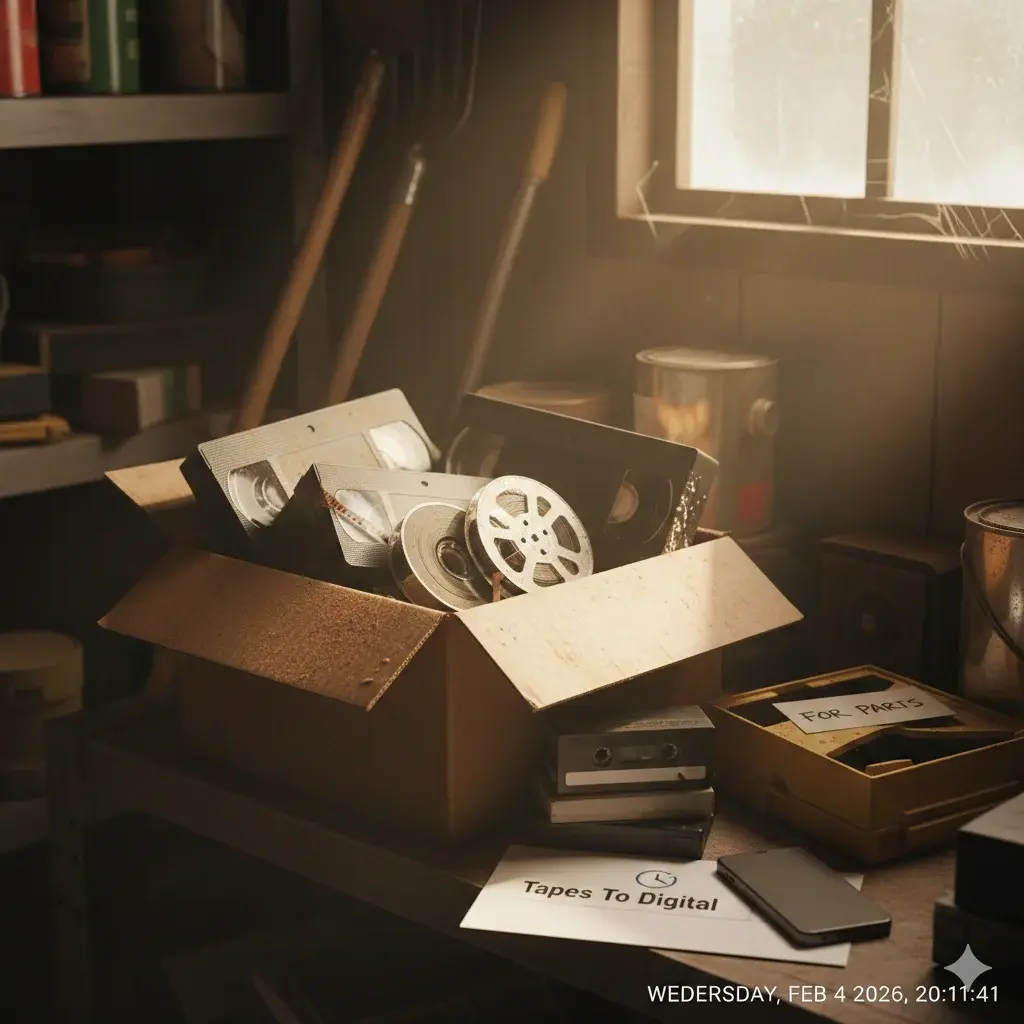
For many Australian families, the cupboard under the stairs or the box in the garage holds a literal treasure trove of history. These containers are filled with VHS tapes of Christmas mornings in the 80s, Super 8 reels of beach holidays at the Gold Coast, and audio cassettes featuring the voices of grandparents who are no longer with us. However, there is a harsh reality that many overlook: these memories are sitting on a biological and mechanical expiration date.
Digitisation is not just a modern convenience; it is a one-time opportunity to rescue your history. Because of the way analog media was manufactured, we are currently living through the final decade where most of this footage can still be recovered. Once the magnetic particles flake off or the film vinegar syndrome sets in, that window of opportunity snaps shut forever.
The Ticking Clock: Why Magnetic Media is Failing
Analog formats like VHS, VHS-C, and Hi8 were never designed to last forever. They were consumer-grade products intended for a lifespan of perhaps 15 to 20 years. Many of the tapes currently sitting in Australian lounge rooms are now 30 or 40 years old.
Magnetic tape consists of a plastic base layer and a magnetic coating held together by a binder. Over time, humidity—a common issue in coastal Australian climates—causes this binder to absorb moisture. This leads to a chemical reaction that makes the tape "sticky." When you finally decide to play that tape to "see if it still works," the sticky residue can actually rip the magnetic coating right off the plastic backing, destroying the footage instantly. This is why transferring VHS to digital should be treated as a priority rather than a weekend chore for "someday."
The Equipment Crisis: Finding a Working VCR
Even if your tapes are in pristine condition, a secondary crisis is unfolding: the disappearance of playback equipment. The last VCR was manufactured in 2016, and professional converters are becoming increasingly rare. Most "op-shop" finds are unserviced and can easily "eat" a fragile tape within seconds of pressing play.
At Tapes To Digital, we utilise well-maintained, professional-grade equipment to ensure that the playback is stable and safe. For many formats, such as Betamax or the pro-level Betacam SP used in Australian broadcasting, finding a working player is nearly impossible for the average consumer. This equipment scarcity means that the cost and difficulty of digitisation will only increase as the years go on.
Chemical Decay and the "Sticky Shed" Syndrome
In Australia, the environmental factors play a massive role in media degradation. Tapes stored in sheds or non-climate-controlled spare rooms are subject to "Sticky Shed Syndrome." This occurs when the urethane binder in the tape breaks down. If you notice a white, waxy substance on the edges of your tape reels, that is often mould or binder breakdown.
If you attempt a DIY VHS conversion on a tape with these issues, you risk ruining both the tape and your playback device. Professional digitisation services include a physical inspection to identify these risks before the tape ever touches a playback head.
One Shot at Success: Why Professional Handling Matters
Because of the fragility of old media, you often only get one chance to get a clean "read" of the data. Every time a 30-year-old tape is played, it loses a tiny bit of its magnetic integrity. When we perform video to digital services in Parramatta, we treat the process as a delicate rescue mission.
Whether it's VHS to USB or Google Drive delivery, we convert legacy formats into high-quality MP4 files, which are the current global standard for compatibility. This ensures that once the physical tape finally gives up the ghost, your digital file will live on in the cloud, on your smartphone, or on a smart TV for the whole family to enjoy.
Modern Benefits: Beyond Just Saving the Footage
Digitisation isn't just about "saving" a file; it’s about making your memories useful again. Once your tapes are converted to digital formats:
-
They are shareable: You can send a link to a cousin in Perth or a sibling in London instantly.
-
They are future-proof: Digital files don't degrade with every "play".
-
They are space-saving: You can finally clear out those bulky plastic cases from your cupboards.
Whether it's MiniDV to digital or converting standard 8mm film reels, the goal is the same: moving your history from a fragile, obsolete medium to one that fits into your modern life.
Why Choose Tapes To Digital?
When dealing with irreplaceable family memories, trust is the most important factor. We pride ourselves on:
-
Honest Communication: We provide realistic expectations based on the condition of your media.
-
Professional Equipment: We use maintained professional converters to ensure the best possible signal capture.
-
Security & Privacy: Your content is kept confidential and handled with the utmost care.
-
Australian Owned: We understand the local context and provide accessible drop-off points or mail-in options via Australia Post.
About Us
Tapes To Digital is a dedicated media preservation business. Our mission is to rescue, preserve, and modernise old, fragile, or obsolete media by converting it into accessible, long-lasting digital formats. We handle everything from VHS and film reels to vinyl records and floppy disks, ensuring that Australia's personal histories are not lost to the march of time.