

 Too busy?
 Back
Back

 What customers say


.png?width=32&height=32&name=Microcassette%20(1).png)


.png?width=32&height=32&name=laser%20disc%20(1).png)

 Digital Services

.webp)
.png)

.png)

%20(70).png)
%20(67).png)
%20(71).png)
%20(1126%20x%20658%20px)%20(4).png)

















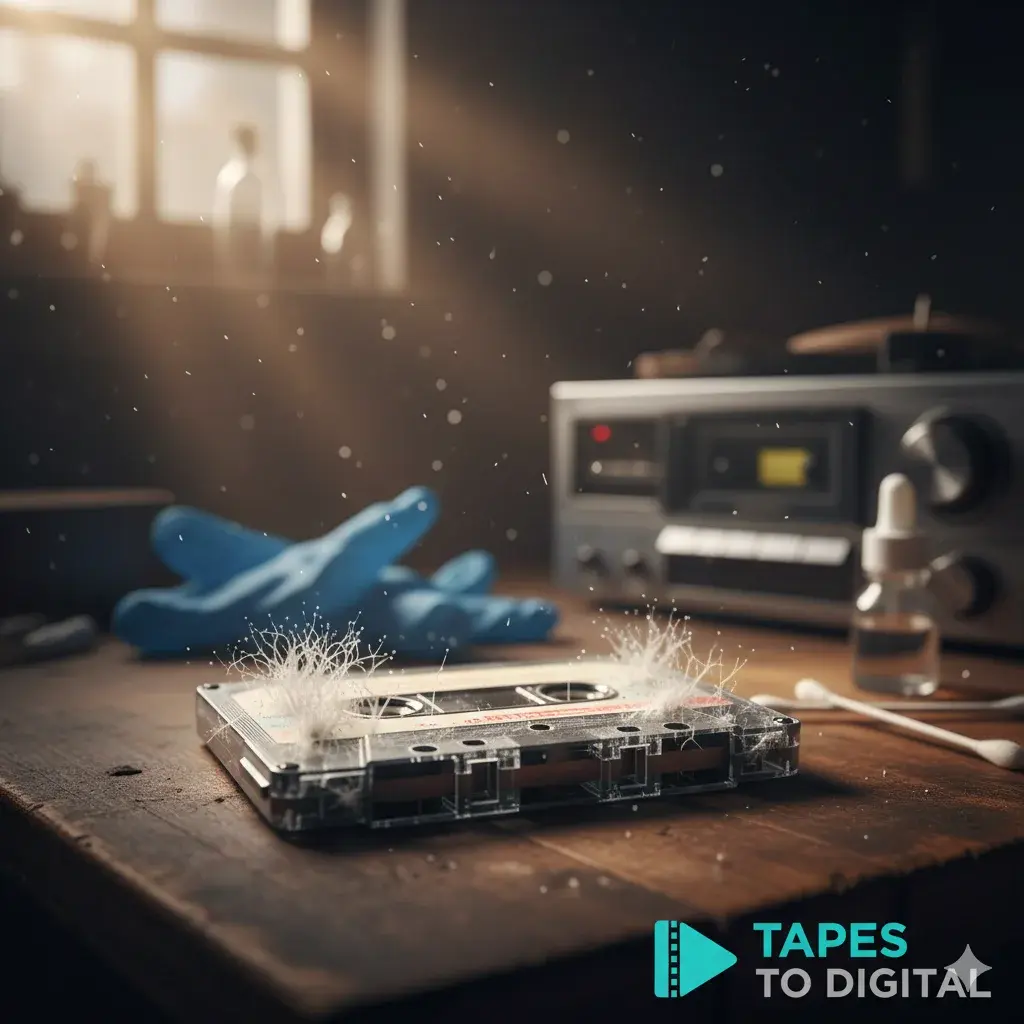
For many Australians, the lounge room cupboard or a box in the garage holds a lifetime of memories captured on audio cassettes. From a child's first words and high school garage band demos to recordings of late family members, these magnetic tapes are priceless. However, there is a silent predator often found lurking in these storage spaces: mold.
If you have pulled out a favourite cassette only to find a white, powdery substance or fuzzy spots visible through the clear plastic casing, your media is under attack. Understanding how to handle moldy audio tapes is the difference between preserving a legacy and losing it to the bin.
The Silent Threat: Identifying Mold on Audio Tapes
Mold on audio media doesn't always look like the green slime you might find on bread. On magnetic tapes, it usually appears as:
-
White powdery residue: Often mistaken for dust, this is frequently found on the edges of the tape pack.
-
Small white spots: These can appear on the surface of the magnetic ribbon itself.
-
Discolouration: A dulling of the tape’s natural dark sheen.
-
A musty odour: That unmistakable "old basement" smell is a primary indicator of active fungal growth.
Because Tapes To Digital performs a physical inspection on every item, we often find that mold is more extensive than it appears from the outside of the shell.
Why Audio Tapes Succumb to Mold in the Australian Climate
Australia’s climate presents unique challenges for media preservation. In coastal regions like Beverly Hills in Sydney or during the humid summers in Queensland, moisture levels in the air provide the perfect breeding ground for fungi.
Magnetic tape is composed of a plastic base, a magnetic oxide layer, and a binder that holds them together. This binder is often made of polyurethane, which is hygroscopic—meaning it absorbs water from the air. When combined with organic dust particles trapped inside the cassette, mold has everything it needs to thrive. Left untreated, the mold eats away at the binder, eventually causing the magnetic layer to flake off, resulting in permanent "dropouts" or total audio loss.
The Risks of Playing Moldy Tapes
The temptation to "just see if it still works" is high, but playing a moldy tape is the fastest way to destroy both the recording and your playback equipment.
-
Contamination: Fungal spores are airborne. Loading a moldy tape into a cassette player spreads those spores throughout the internal mechanism, contaminating every other tape you play afterward.
-
Physical Damage: Mold makes tape sticky. As it passes through the player, it can wrap around the capstan or clog the playback heads, causing the tape to snap.
-
Clogged Heads: The mold residue acts like sandpaper, physically abrading the delicate heads of the cassette player.
Why DIY Cleaning Often Does More Harm Than Good
You may find "life hacks" online suggesting the use of isopropyl alcohol and cotton buds to clean tapes. We strongly advise against this for several reasons. Cassette tapes are incredibly fragile. Applying the wrong pressure or chemical can dissolve the binder entirely. Furthermore, cleaning the visible part of the tape doesn't address the spores buried deep within the tightly wound reel. The danger of DIY options for digitising is real, and the risks apply just as heavily to audio as they do to video.
The Professional Restoration and Digitisation Process
At Tapes To Digital, we treat every item with professional care and honesty. When a moldy tape arrives via an Australia Post courier satchel, it undergoes a specialised workflow:
-
Assessment: We evaluate the extent of the damage.
-
Cleaning: The tape is subjected to a professional cleaning process to remove loose spores and debris without damaging the magnetic ribbon.
-
Stabilisation: In some cases, tapes require "baking" or climate-controlled stabilisation to ensure they can survive one final pass through our professional converters.
-
Real-Time Capture: Once stable, we perform a professional audio tape digitisation to create a high-fidelity digital file.
Preventing Future Growth: Storage Tips for the Australian Home
Once you have converted your cassette to digital, you should still protect your originals:
-
Avoid the Garage: Never store tapes in sheds, garages, or attics where temperature fluctuations are extreme.
-
Airflow: Store tapes in a "living" area of the house where air conditioning or natural airflow keeps humidity low.
-
Vertical Storage: Store cassettes vertically, like books on a shelf, to prevent the tape pack from sagging.
Why Choose Us
We understand that your audio tapes are irreplaceable. Whether it’s a vinyl record to digital project or a moldy microcassette, we provide:
-
Honest Communication: We never promise results that the original media cannot provide.
-
Privacy: Your recordings are kept strictly confidential.
-
Standard Formats: We deliver in high-quality MP3 or archival WAV formats.
About Us
Tapes To Digital is Australia’s trusted media preservation partner. From VHS to digital to specialist film reels, our mission is to rescue memories from obsolete formats. With drop-off points in suburbs like Greenvale and mail-in options nationwide, we make it easy to future-proof your history.